From punctuation to participles, understand the rules that govern the English language. Clear explanations, zero jargon.
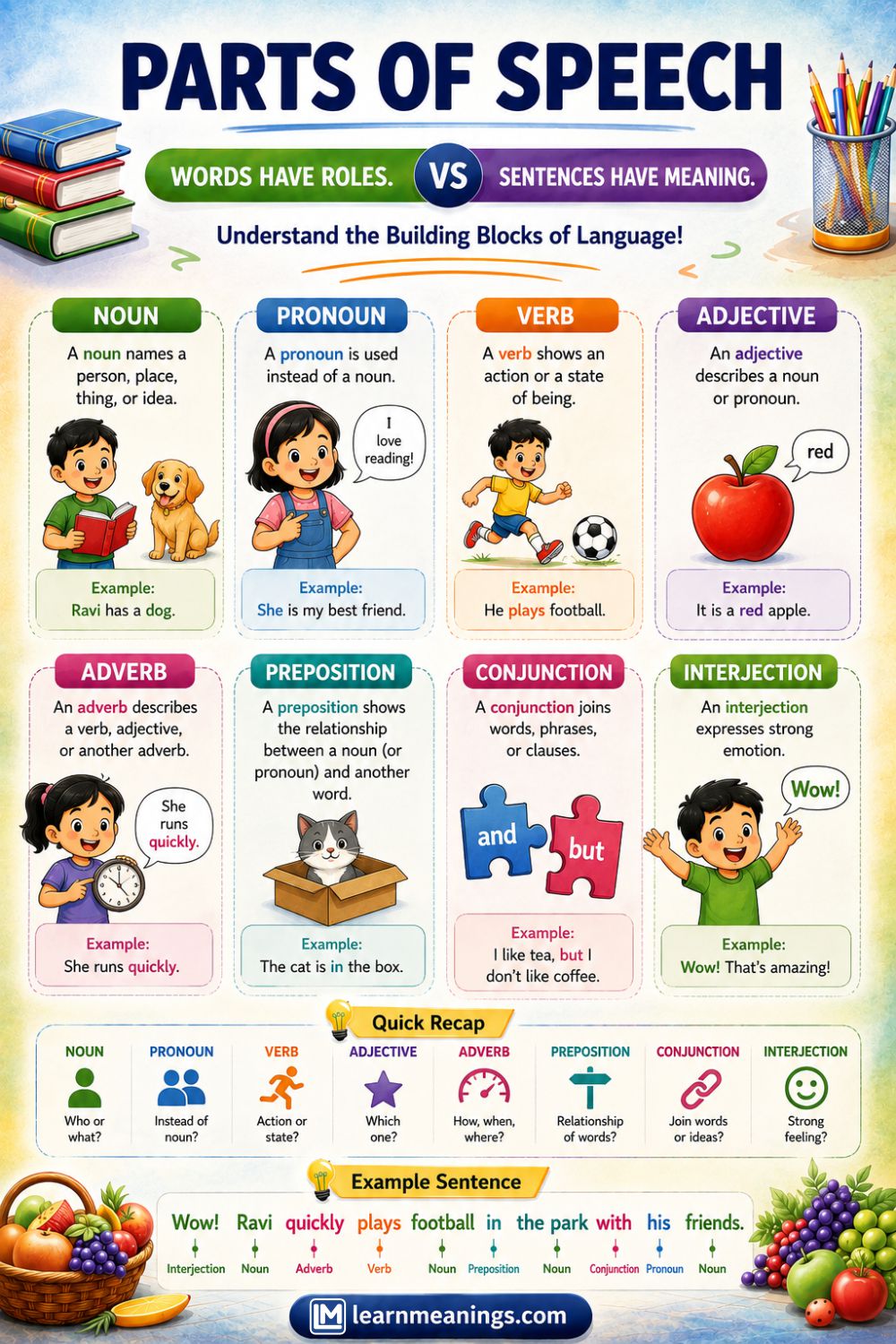
Every word in English falls into one of these categories. Know them to master sentence structure.
Person, place, thing, or idea. (Dog, City)
Action or state of being. (Run, Is)
Describes a noun. (Blue, Tall)
Modifies a verb. (Quickly, Very)
Replaces a noun. (He, They)
Shows relationship. (In, On, At)
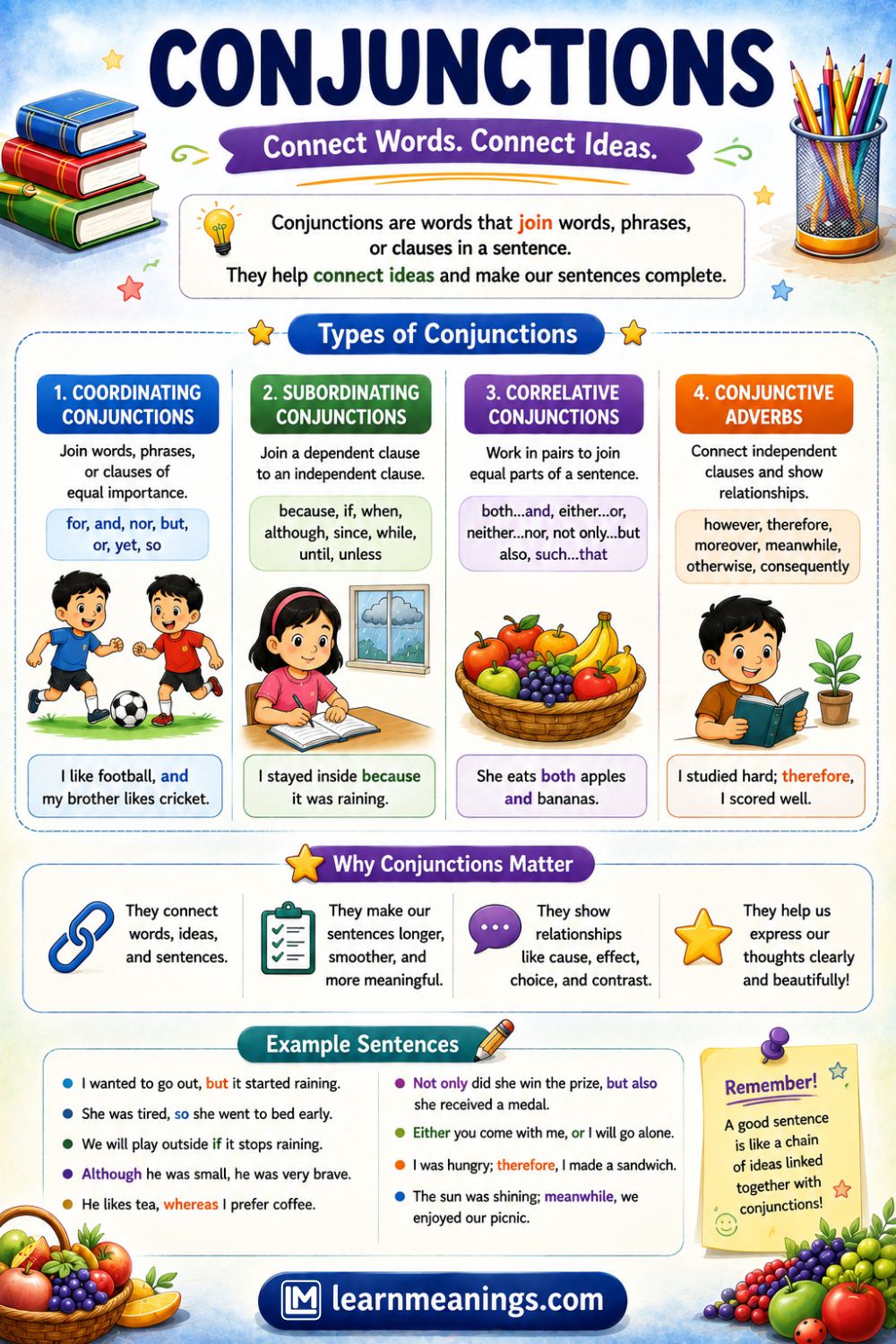
Joins words. (And, But)
Expresses emotion. (Wow, Ouch)
A single misplaced comma can change the entire meaning of a sentence.
Indicates a short pause. Separates items in a list or independent clauses.
"I bought apples, bananas, and oranges."
Links two related independent clauses without using a conjunction.
"The sun is setting; the sky is beautiful."
Introduces a list, a quote, or an explanation. The clause before it must be complete.
"She had one goal: to win."
Shows possession or indicates omitted letters in a contraction.
"John's car" / "Don't go"
Every sentence is built on a formula. Here are the four types.
"The dog barked."
"The dog barked, and the cat ran."
"Because it rained, we stayed inside."
Even native speakers mess these up. Here's the correct usage.
"Your going to be late."
"You're going to be late."
"The dog lost it's bone."
"The dog lost its bone."






Explore our extensive dictionary using different filters and categories.
Take this 50-question quiz to test your vocabulary knowledge.
1. Which geographical name requires 'the'?
2. What is the passive form of 'She has finished the work'?
3. Choose the correct question form.
4. Identify the noun: 'The dog barked loudly.'
5. Find the conjunction: 'I want tea, but he wants coffee.'
6. Which word means 'the state of being dark'?
7. Which sentence correctly ends with a preposition?
8. Convert to active: 'The room is cleaned every day.'
9. Which sentence is a compound sentence?
10. Which sentence is exclamatory?
11. Which sentence is correct?
12. What does the prefix 'sub-' mean?
13. What type of sentence is 'Wow, that was an amazing show!'
14. Which sentence uses the zero article (no article) correctly?
15. What is the causative passive structure?
16. Which sentence uses a modal helping verb?
17. Which sentence correctly omits 'the' for a proper noun?
18. What is the purpose of an interrogative sentence?
19. Identify the prepositional phrase: 'The book on the table is mine.'
20. Which word is a preposition?
21. Why is the passive voice common in scientific writing?
22. Identify the subordinating conjunction: 'We will leave when the rain stops.'
23. Choose the correct article: He is ___ European citizen.
24. What is the helping verb in the negative sentence: 'They do not like spinach.'
25. Convert to passive: 'Someone stole my wallet.'
26. Which sentence is a run-on?
27. What is the difference between 'between' and 'among'?
28. Which word is the formal equivalent of 'buy'?
29. How do you fix a run-on sentence?
30. Choose the correct preposition: This gift is ___ you.
31. Which sentence uses Past Perfect?
32. Fill in the blank: She is interested ___ learning French.
33. Which is a complex sentence?
34. Which is a coordinating conjunction?
35. Complete: 'By 2025, I ___ graduated.'
36. Which modal verb expresses a strong obligation?
37. Which sentence uses parallel structure?
38. Which pronoun should be avoided in academic writing?
39. Identify the adverb: 'She sings beautifully.'
40. Which helping verb is used in a tag question: 'She is a doctor, ___ she?'
41. Which is a stative verb?
42. Which preposition is commonly used to introduce the agent in a passive sentence?
43. Which tense is used for habits and facts?
44. Identify the voice: 'The thief was caught by the police.'
45. Choose the correct preposition: We arrived ___ the airport late.
46. Choose the correct preposition: The plane flew ___ the clouds.
47. What does the prefix 'anti-' mean?
48. What punctuation ends an imperative sentence that is a forceful command?
49. Which sentence uses Simple Past correctly?
50. What does the prefix 'mis-' mean?
The Oxford comma (or serial comma) is the comma placed immediately before the conjunction (usually "and" or "or") in a list of three or more items. Example: "I bought apples, bananas, and oranges." While optional in casual writing, it is highly recommended in academic and professional writing to prevent ambiguity.
A semicolon is used to connect two independent clauses that are closely related in thought, without using a coordinating conjunction like "and" or "but". It can also be used to separate items in a complex list where the items themselves contain commas.
A dangling modifier is a word or phrase that modifies a word not clearly stated in the sentence. For example, "Walking down the street, the trees were beautiful." (The trees weren't walking). To fix it, add the subject: "Walking down the street, I saw the beautiful trees."
"Who" is a subjective pronoun, meaning it performs the action (like he or she). "Whom" is an objective pronoun, meaning it receives the action (like him or her). A quick trick is to replace the word with 'he/him' or 'she/her'. If 'him' works, use 'whom'.
Most of the time, "affect" is a verb meaning to influence (e.g., The weather affects my mood), and "effect" is a noun meaning the result (e.g., The effect of the storm was devastating).
