Master the trickiest spellings in the English language. Check your spelling instantly, learn the rules, and discover memory tricks to write flawlessly.
English borrows from dozens of languages, creating spelling chaos. Here are the main culprits.
Words aren't spelled like they sound. "Knife" and "Psychology" ignore their first letters entirely.
Knowing when to double up is hard. Address vs. Adept, Embarrass vs. Excite.
Latin, Greek, and French roots bring strange rules. "Rhythm" comes straight from Greek.
Ghost letters haunt our words. Why is there a 'B' in "Debt" or a 'C' in "Scissors"?
These are the words that trip up writers the most. Don't let them trip you.
Learn the difference between words that sound alike but are spelled differently.
Affect
Effect
Tip: "Affect" is usually a verb (Action), "Effect" is usually a noun (End result).
Loose
Lose
Tip: "Lose" is to misplace something. "Loose" means it's not tight.
Principal
Principle
Tip: A "Principal" is your pal. A "Principle" is a rule or belief.
Are you writing for a US or UK audience? Know the crucial differences.
It's not just about letters; it's about punctuation. These are the worst offenders.
Wrong: The dog lost it's bone.
Right: The dog lost its bone. (Possessive has no apostrophe!)
Wrong: Your going to be late.
Right: You're going to be late. (Contraction of "You are").
Wrong: Their going over there.
Right: They're going over there.
Wrong: I want to go to.
Right: I want to go too. (Means "also" or an excess).
Easy ways to remember the hardest spelling rules in English.
Use "ie" as in Believe and Achieve. Use "ei" after C as in Receive and Conceive.
A shirt has one collar and two sleeves. So, one 'C' and two 'S's.
To accommodate someone, you need two beds (C's) and two mattresses (M's).
When making a word plural, don't just slap an 'S' on the end.
Y to IES
Baby → Babies
If it ends in Y, drop Y, add IES.
F to VES
Leaf → Leaves
Ends in F or FE, change to VES.
US to I
Cactus → Cacti
Latin words ending in US become I.
IS to ES
Analysis → Analyses
Greek words ending in IS become ES.
Misspelling these words at work can damage your credibility.
Find misspelled words grouped by where people struggle the most.
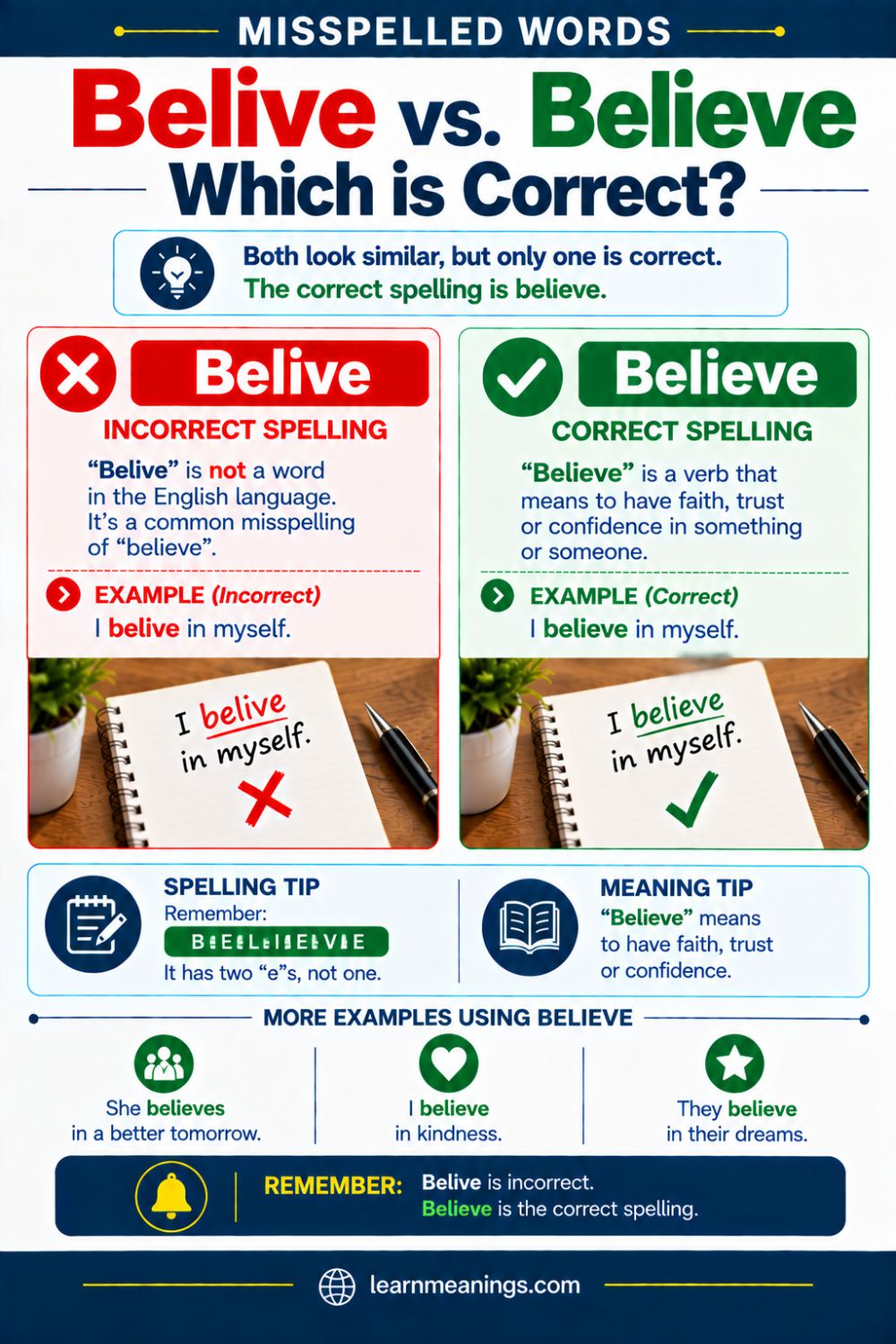
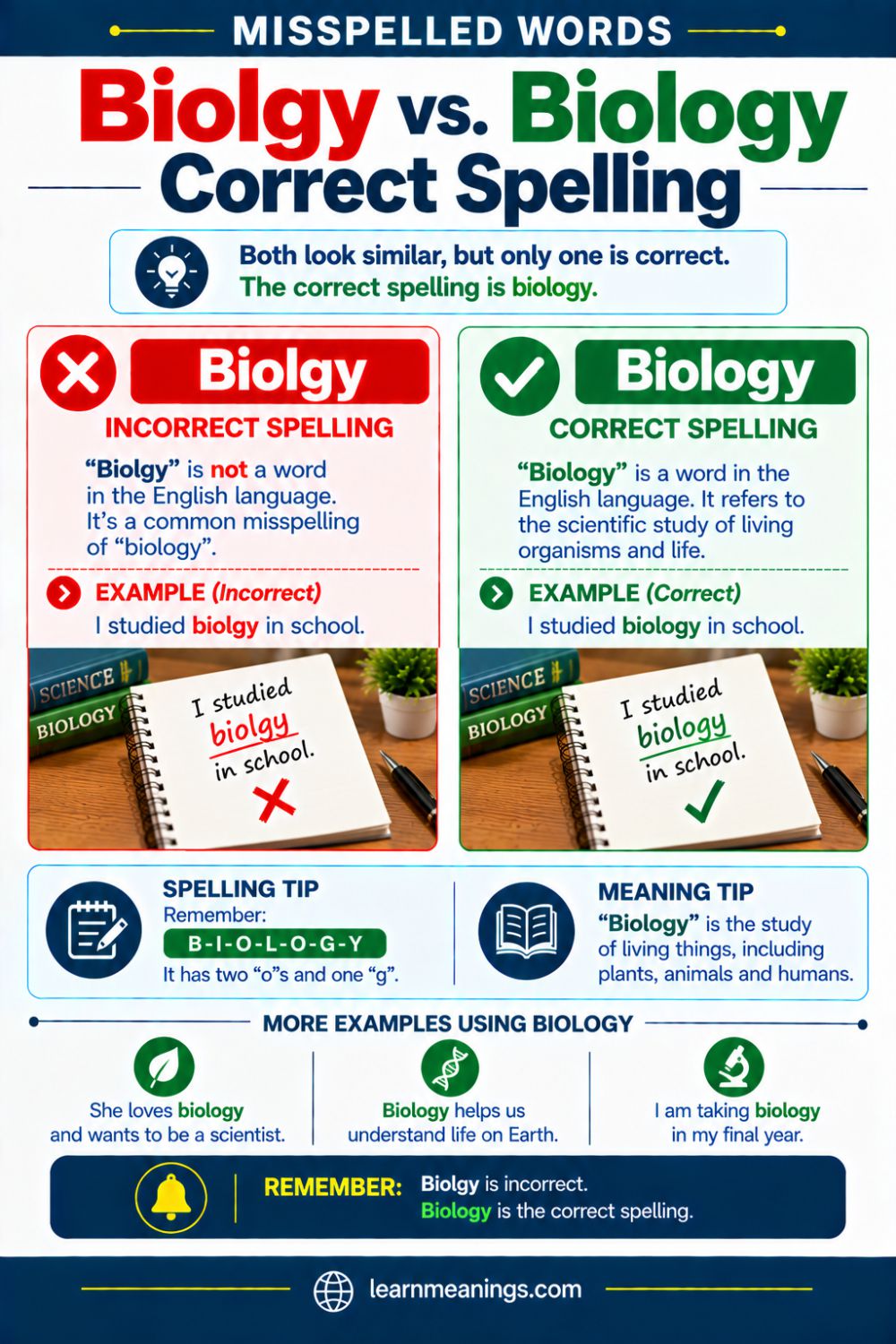
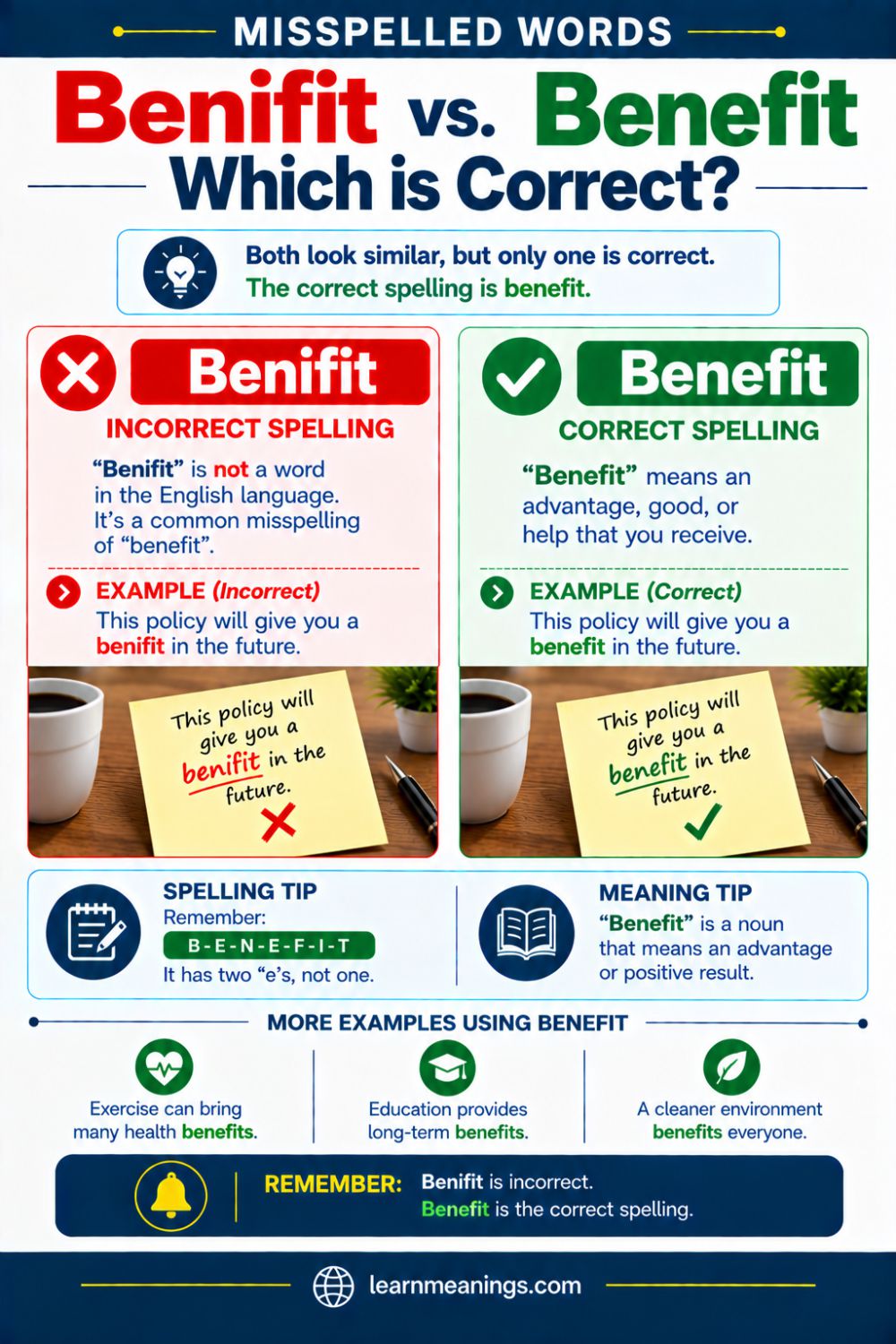


Explore our extensive dictionary using different filters and categories.
Take this 50-question quiz to test your vocabulary knowledge.
1. What does 'controversy' mean in the sentence: 'The movie casting caused controversy'?
2. Which memory trick helps you remember the spelling of 'disgusting'?
3. What is the correct spelling of the verb meaning 'to dust a surface with baking powder'?
4. Which of the following is a synonym for 'doesn't' (in the context of 'doesn't work')?
5. What is wrong with the sentence: 'Your comments are very flatterring.'
6. How many syllables are in the word 'committee'?
7. Which of the following is the correct spelling of the ordinal number after seventh?
8. What is the correct noun form of the adjective 'formidable'?
9. Which of the following is an antonym in the context of academic disciplines?
10. The word 'foresee' derives from which language's predecessor?
11. The double 's' in 'colossal' comes from which root word?
12. Which of these words shares the same Latin root ('temptare') as 'attempt'?
13. What is wrong with the sentence: 'We had a breif chat.'
14. The word 'dilemma' features double letters in how many separate places?
15. What is the correct adjective form meaning 'inept or unskillful'?
16. Which of the following is an antonym for 'foreign'?
17. A helpful trick to remember the 's' in 'especially' is that it contains which smaller word?
18. Which of the following is a synonym for 'automatically'?
19. Which of the following is the correct spelling in American English?
20. The noun form of the verb 'begin' is:
21. What does 'definite' mean in the sentence: 'The doctor noticed a definite change in the patient's vitals'?
22. In the sentence 'I caught a cold', what part of speech is 'caught'?
23. The word 'fare' (meaning a fee) derives its root from which Old English word?
24. Which of the following is an antonym for 'disapprove'?
25. A helpful trick to remember the first 'r' in 'frustrated' is to think of:
26. What does 'fabulous' mean in the sentence: 'The fabulous unicorn is a myth'?
27. Which memory trick helps you remember the spelling of 'cemetery'?
28. Which of the following is an antonym for 'conceive'?
29. What is wrong with the sentence: 'Please do not critisize my cooking.'
30. Which memory trick helps you remember the spelling of 'efficient'?
31. A helpful trick to remember the double 'R' is that it stands for:
32. Which memory trick helps you remember the spelling of 'dilemma'?
33. Is 'formidable' spelled differently in British English?
34. Why is 'annually' frequently misspelled as 'anually'?
35. What does 'aggression' mean in the sentence: 'The coach told the team to channel their aggression into defense'?
36. In the sentence 'I will definitely call you', what part of speech is 'definitely'?
37. Is 'disappoint' spelled differently in British English?
38. What is the correct adjective root of 'especially'?
39. Which memory trick helps you remember the spelling of 'attempt'?
40. Which of the following is a synonym for 'corrupt'?
41. What is the correct noun form of 'imminent'?
42. What is the correct spelling of the adjective form meaning 'relating to the regions around the South Pole'?
43. Complete the sentence: 'The glass will ___ if you drop it.'
44. 'Annually' is a unique word because it features double letters in how many separate places?
45. In American English, on which syllable is the stress placed when pronouncing 'author'?
46. Why is 'fiery' frequently misspelled as 'firey'?
47. A helpful trick to remember the spelling of 'arctic' is to think of:
48. Why is 'ensure' preferred over 'make sure' in business emails?
49. Which of these words shares the same Latin root ('mittere') as 'committee'?
50. In American English, on which syllable is the stress placed when pronouncing 'concede'?
Commonly misspelled words are words that people frequently write incorrectly. These often include words with double letters (like 'accommodate'), silent letters (like 'rhythm'), or words that don't sound the way they are spelled (like 'Wednesday').
English spelling is difficult because the language has borrowed words from many other languages like Latin, French, and German. As a result, English has many irregular spelling rules, exceptions, and words that sound the same but are spelled differently (homophones) like 'their', 'there', and 'they're'.
To stop misspelling words, you should learn common spelling rules, break long words into smaller syllables, and memorize exceptions. Reading regularly and keeping a personal list of words you frequently struggle with can also help you improve your spelling skills over time.
Words like 'definitely', 'separate', 'accommodate', and 'occurrence' are consistently ranked among the most misspelled words in the English language. People often misspell them by adding extra letters or substituting vowels incorrectly.
'Misspelled' and 'misspelt' are both correct past tense forms of the verb 'misspell'. 'Misspelled' is the preferred spelling in American English, while 'misspelt' is more commonly used in British English.
