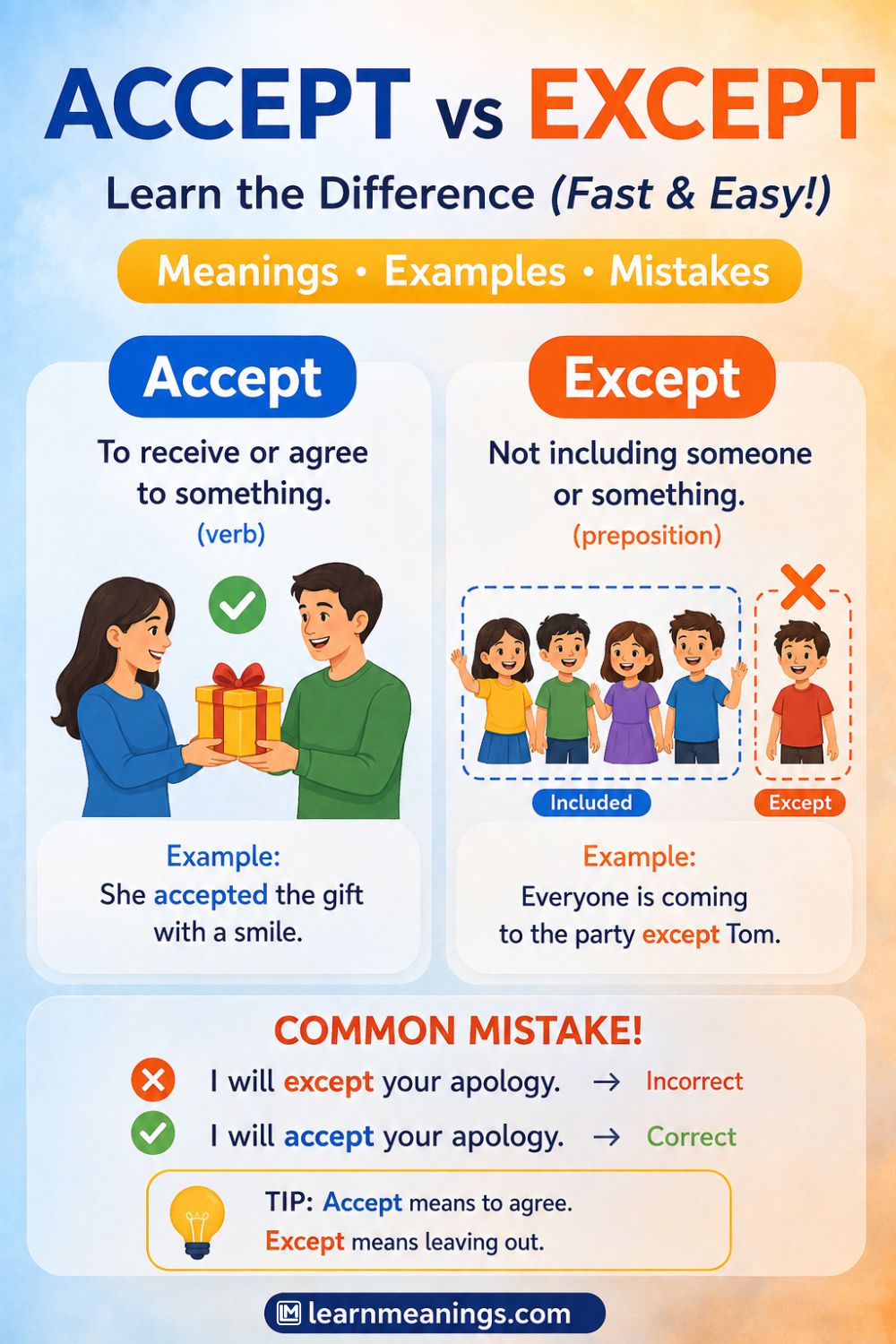
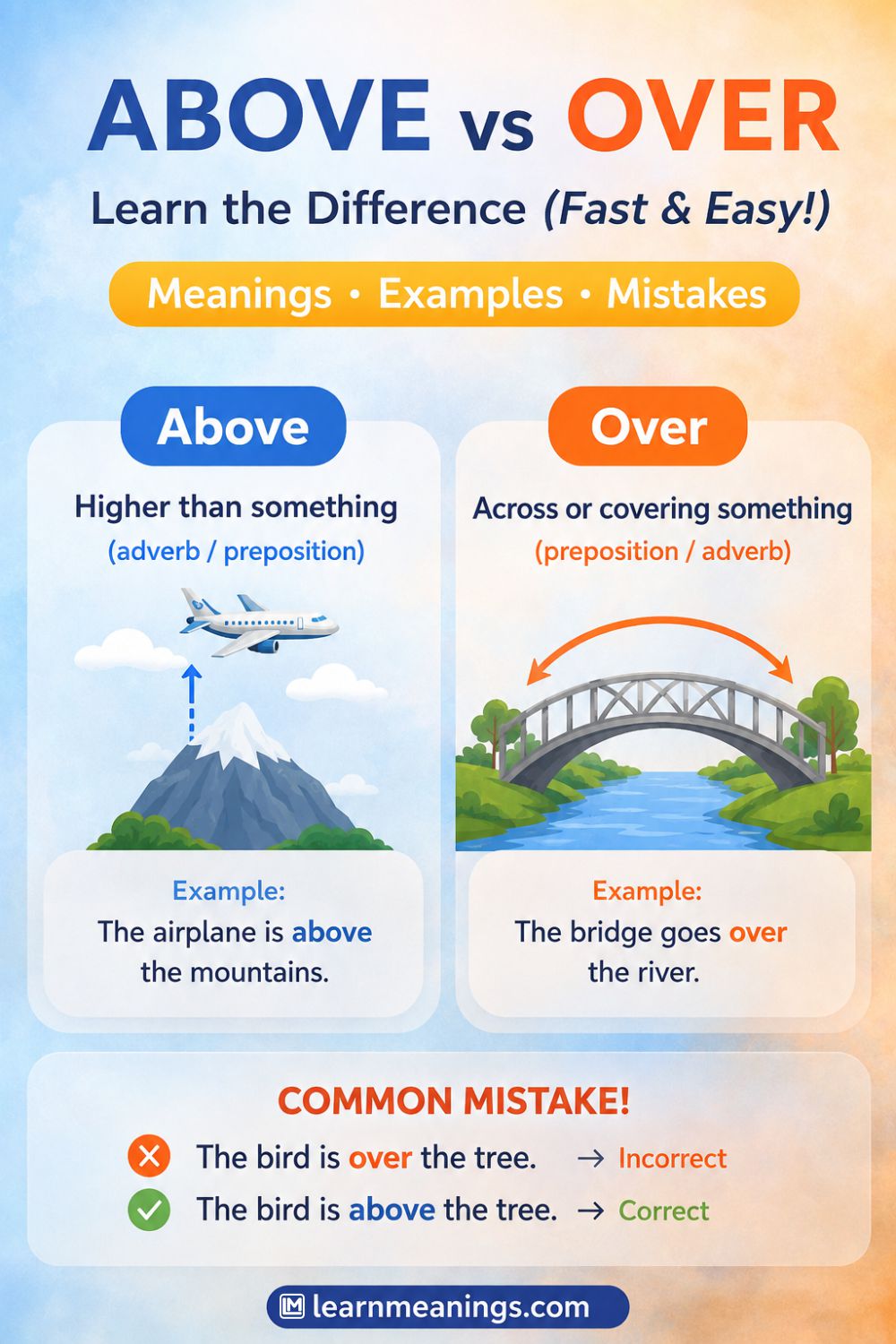
Stop mixing up commonly confused words. Learn the clear rules, memory tricks, and exact contexts for when to use which word.
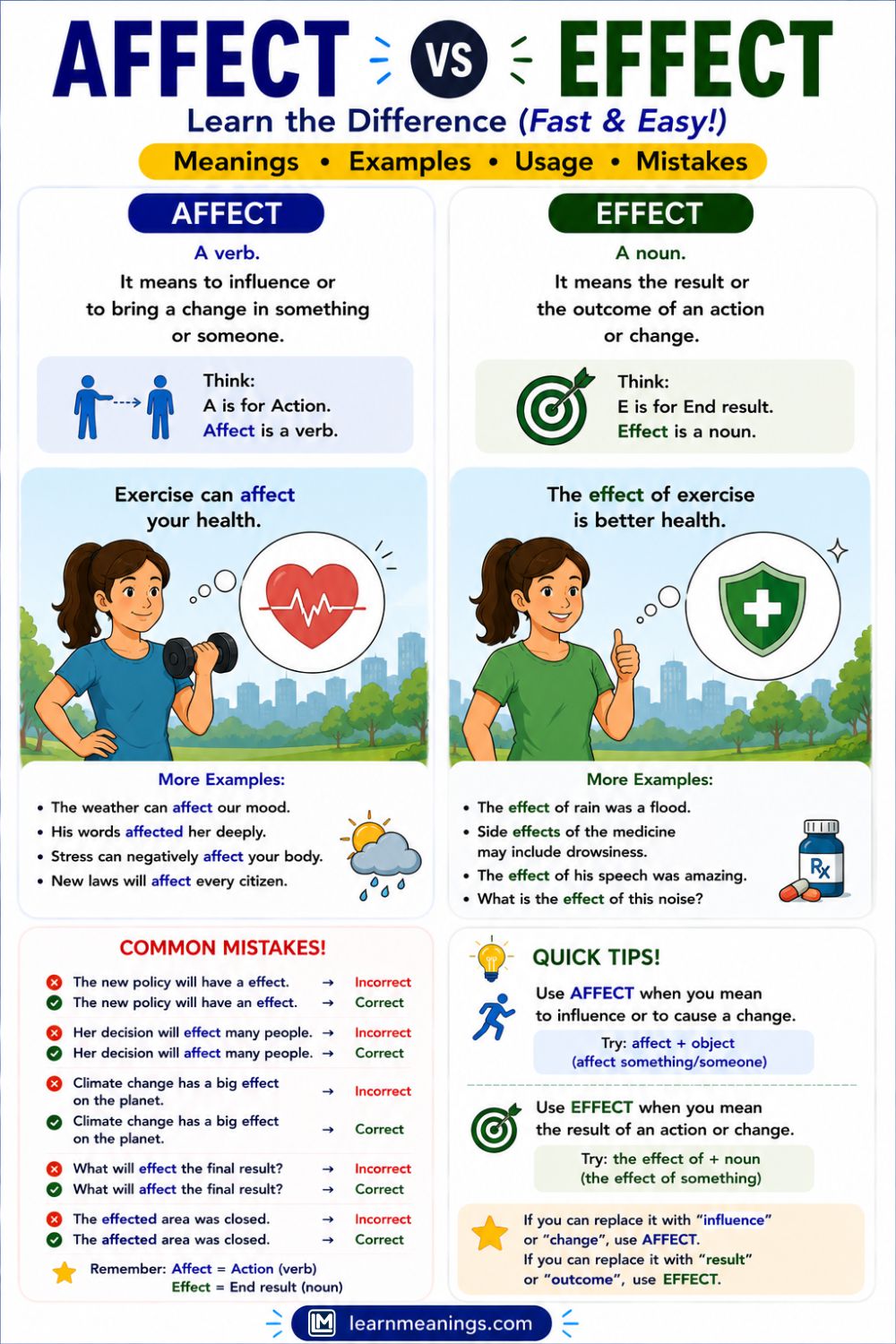
The golden rule: "Affect" is usually an Action (Verb), "Effect" is usually an End result (Noun).
Verb (Action)
To influence or produce a change in something.
Example
"The rain will affect our picnic."
Noun (End Result)
The result of a change or the outcome of an action.
Example
"The rain had a negative effect on our picnic."
Quick rules for the most commonly mixed-up words in English.
Then
TimeThan
CompareThen relates to time. Than is used for comparisons.
Lose
VerbLoose
AdjectiveLose means to misplace. Loose means not tight.
Who
SubjectWhom
ObjectWho performs the action. Whom receives the action.
Principal
Person/RulePrinciple
BeliefPrincipal is your pal or main. Principle is a law or rule.
Stationary
StillStationery
PaperStationary means not moving. Stationery is paper (with an E for Envelope).
Compliment
PraiseComplement
CompleteCompliment is praise. Complement means to complete or enhance.
Simple mental shortcuts to lock the correct usage into your brain forever.
Dessert has two 'S's because you always want a second piece. Desert has one 'S' because it's just sand.
Remember: Affect = Verb, Effect = Noun. RAVEN will save you every time.
Stationery (with an E) is for Envelopes. Stationary (with an A) is for At rest.
Words that sound identical but have completely different spellings and meanings.
There = Location. Their = Possession. They're = They are.
To = Direction. Too = Also/Excessive. Two = Number 2.
Right = Correct/Direction. Write = Create text. Rite = A ceremony.
See how swapping the wrong word for the right one fixes the meaning instantly.
"There are less cars on the road today."
"There are fewer cars on the road today."
"I am taller then him."
"I am taller than him."
Same meaning, completely different words. Here are the most common variations.
US ↔ UK
US ↔ UK
US ↔ UK
US ↔ UK
The English language is weird. These words have two completely opposite meanings depending on context.
Meaning 1: To stick together tightly.
Meaning 2: To split apart forcefully.
Meaning 1: To remove fine particles (cleaning).
Meaning 2: To add fine particles (like sugar on a cake).
Meaning 1: To supervise or watch carefully.
Meaning 2: To fail to notice or ignore.
Explore our extensive dictionary using different filters and categories.
Take this 50-question quiz to test your vocabulary knowledge.
1. The corrupt politician was ______ by a heavy conscience in his final years.
2. The startup ______ed its rapid user growth to secure venture capital.
3. What is the adjective form of 'sympathy'?
4. What is the main difference between 'in' and 'into'?
5. The business model must be ______ to survive the economic downturn.
6. The speedy car ______ us on the highway.
7. Which of the following is a common collocation?
8. The students waited patiently ______ the professor finished the lecture.
9. The prize money was divided ______ the three winners.
10. The students ______ed the teacher's authority by refusing to sit down.
11. The dog behaves ______ when guests arrive.
12. I found some ______ change in my pocket.
13. The convicted murderer was ______ by the state.
14. Seeking legal ______ is a smart move before starting a business.
15. Which of the following is a common collocation for 'counsel'?
16. Which of the following is a common collocation for 'capitol'?
17. Is 'American Idle' or 'American Idol' the correct name for the TV show?
18. The rivals ______ on the beach at dawn.
19. Which sentence is grammatically correct?
20. Can I give you a piece of ______?
21. Your argument is completely ______ the point.
22. I can tell ______ getting dark outside.
23. The company ______ bankrupt after the economic crash.
24. Which word is an adjective?
25. The company's ______ performance exceeded Wall Street expectations.
26. Can 'role' be used as a verb?
27. Which memory trick helps distinguish these words?
28. Which of the following is a common collocation for a moral rule?
29. He drives ______ fast.
30. A cure for the common cold has long ______ scientists.
31. What is the present participle of 'lay'?
32. The new competitor ______ our market share considerably.
33. Which memory trick helps distinguish these words?
34. The fence runs ______ the two neighboring properties.
35. What is the pronunciation difference between morning and mourning?
36. We stayed up ______ to finish the project.
37. If you have questions, ask the supervisor or ______.
38. Let's fast ______ through the boring part of the movie.
39. The mechanic informed me that my ______ pads are completely worn out.
40. The ______ fleet was deployed to the Atlantic.
41. The ______ student fell asleep during the boring lecture.
42. Which of the following is a common mistake?
43. This gift is ______ you.
44. The soldier was punished for trying to ______ his post.
45. The festival ______ with the Independence Day fireworks.
46. Which of the following is a common collocation for 'foreword'?
47. Which sentence is grammatically and contextually correct?
48. When someone asks 'How are you?', what is the most grammatically precise response to indicate good health?
49. Which of the following is a common collocation for 'for'?
50. The main issue ______ is a lack of communication.
Yes, in psychology, "affect" (pronounced AFF-ect) is a noun meaning an expressed emotion. However, in 99% of everyday writing, "affect" is a verb and "effect" is a noun. Stick to the RAVEN rule unless you are writing a psychology paper.
In modern conversational English, "whom" is slowly fading out. However, it is still strictly required in formal, academic, and professional writing. If you can replace the word with "him" or "her," you should use "whom." If you can replace it with "he" or "she," use "who."
Use "fewer" for things you can count (fewer cars, fewer apples). Use "less" for things you cannot count individually (less water, less time). The classic example is the grocery store express lane: it should say "10 Items or Fewer," not "10 Items or Less."
"Its" is a possessive pronoun, meaning belonging to it (e.g., "the dog wagged its tail"). "It's" is a contraction of "it is" or "it has" (e.g., "it's raining"). If you can replace the word with "it is" and the sentence still makes sense, use "it's" with an apostrophe.
"Then" is used for time and sequence (e.g., "we ate dinner, and then we went home"). "Than" is used for comparisons (e.g., "a watermelon is bigger than an apple"). A good trick is to remember that "thAn" compares, and "thEn" tells you whEn.